

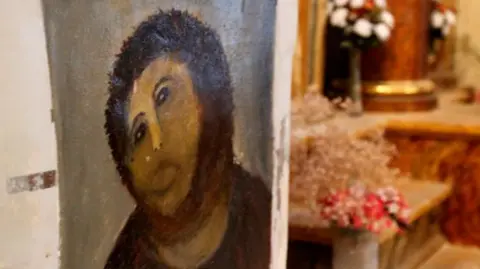
The Spanish parishioner who made international headlines for her infamous repair job on a cherished religious painting has passed away at the age 94.
The woman, a resident of the town of Borja in northeast Spain, rose to prominence 13 years ago after she undertook to restore a 100-year-old painting titled Ecce Homo housed within her parish church.
Giménez's handiwork spread across the internet and was dubbed "Potato Jesus", largely due to the resulting likeness of Christ's head bearing a resemblance to a hairy monkey.
Local Announcement and Homage
The nonagenarian's death was announced by Borja's mayor, Eduardo Arilla, via an online statement, where he acknowledged her as a "great enthusiast of painting from a young age".
"Descansa en paz Cecilia, your memory will live on with us," Arilla wrote.
Arilla further referenced Giménez's "now-legendary restoration of Ecce Homo" in August 2012, which "due to the deteriorated condition it was in, Cecilia, acting in good faith, decided to apply new paint over the original".
The Artwork's History and the Fateful Act
The Ecce Homo ("Behold the Man" in Latin) by 19th century painter Elias Garcia Martinez had been held for more than a century in the Sanctuary of Mercy Church near Zaragoza.
At the time, Giménez, then 81, stated that parishioners had "traditionally fixed everything here", and that she had received permission from the local priest to proceed.
She also noted that anybody who entered the Church would have observed she was applying paint to the existing image.
A Surprising Economic Lifeline
The impact of the restoration spawned the "Monkey Christ" meme and saw the once quiet town of Borja quickly become a major visitor attraction.
The municipality, which had previously welcomed just 5,000 tourists per year, attracted over 40,000 tourists by 2013, and managed to raise over €50,000 for charity from the attention.
Today, local authorities estimate that somewhere around 15,000 and 20,000 tourists visit Borja each year to see the famous portrait, which is now displayed behind a pane of glass.
Later Life and Community Admiration
Following the wave of criticism, with support from the townspeople and well-wishers around the world, Giménez went on to hold an art exhibition featuring 28 of her own paintings.
She was commended by the mayor for her kind-hearted nature and years of faithful service to the parish.
In the end, what began as a well-intentioned but flawed act of restoration created an improbable cultural icon and brought remarkable tourist revenue to a small Spanish town.


